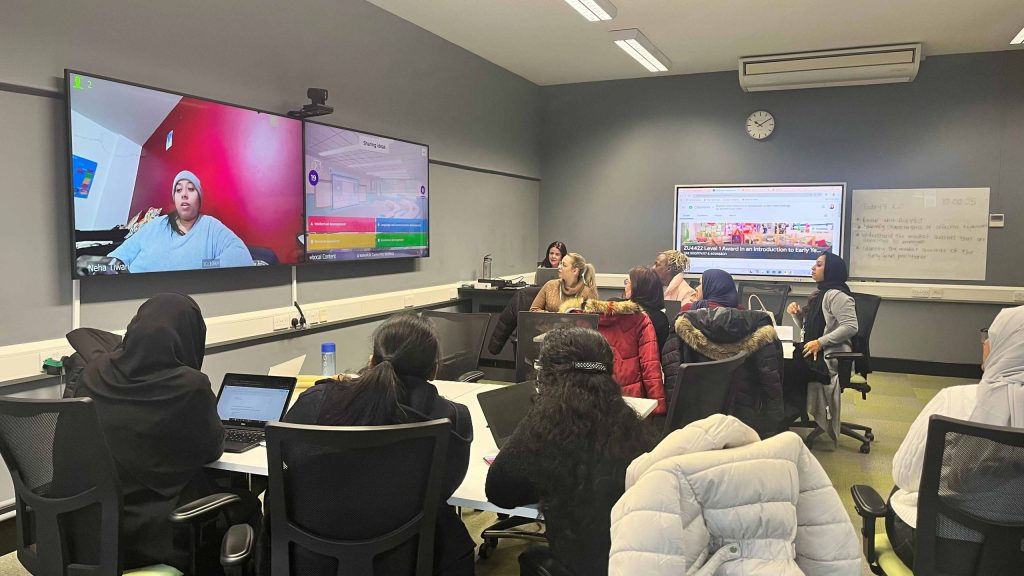
Finding something that worked for our learners and making it stick. That’s why Redbridge Institute of Adult Education won the Learning with Technology Award (sponsored by Ufi VocTech Trust) at the 2025 Get the Nation Learning Awards. Most of our learners are part-time, many are returning to education after a long break and a large proportion speak English as an additional language. Often, confidence is the biggest barrier.
We have long supported learners to prepare for interviews. But there is a limit to what can be achieved in a traditional classroom setting. For some, practising in front of others can feel daunting, even prohibitive. Introducing Bodyswaps gave us a different approach. Through laptop-based immersive simulations and AI-driven feedback, learners can rehearse real-world scenarios, receive immediate insight, and refine their performance over time.
What matters most is not the technology itself, but what it enables: learners can practise independently, repeat scenarios as often as needed, and crucially, make mistakes in a safe, environment. That space to ‘fail safely’ has proved transformational. We have seen learners grow in confidence, perform more effectively in interviews and progress into employment.
The lesson for the sector is clear: technology is only as effective as the way it is implemented. Based on our experience, there are five principles that have made the difference.
1. Start with the learner – not the technology
We did not set out to introduce virtual reality. We started with a simple question: what do our learners need that we are not currently able to provide? The answer was clear – more opportunities to practise real-world skills beyond the classroom. Technology followed that need. Not the other way around.
2. Make it part of your organisational culture
This has not been a standalone initiative. Since the pandemic, digital development has been a strategic priority across the institute. We have invested in capability, but just as importantly, we have created the conditions for experimentation. We designated last year as ‘a year of CPD’, giving staff both the expectation and the permission to develop their practice. Since lockdown, developing our use of digital technology has been a consistent priority across the organisation. We’ve invested in it, but more importantly, we’ve built it into how we think about teaching and learning.
3. Invest in people, not just platforms
Technology succeeds or fails on confidence. We invested in dedicated support through a learning technologist, structured training, and peer champions within curriculum areas. We ensured staff were supported when things didn’t go to plan, because that is when you can lose their backing. One of the most encouraging outcomes has been seeing previously hesitant colleagues become advocates for digital approaches. That cultural shift is where long-term impact sits.
4. Prioritise access and inclusion
A big concern for us was making sure learners weren’t disadvantaged by technology. Not everyone has access to devices at home or is confident using them. We addressed this directly by making Chromebooks available for learners to borrow, enabling use both in and outside the classroom, and keeping platforms as intuitive as possible. For part-time learners in particular, this flexibility is essential. It allows them to engage on their own terms, at their own pace, and with greater independence.
5. Be pragmatic about cost – and collaborate
Not all technology is affordable, and not all innovation is sustainable. We were able to introduce this approach by using the Local Skills Improvement Fund, but long-term viability required clear evidence of impact. Collaboration has been equally important. Working alongside other providers, sharing learning and aligning with existing initiatives has allowed us to scale impact without duplicating cost.
Getting started
If there is one message I would share with colleagues across the sector, it is this: do not wait for a perfect strategy. We began with a clear need, tested an approach, and evolved from there. Some elements worked immediately; others required refinement.
What matters is momentum. When implemented thoughtfully, digital tools can expand what is possible in teaching and learning. They can build confidence, unlock opportunity, and support progression into work.
Technology alone will not transform education. But in the right context – with the right intent, culture and support – it can make a meaningful and lasting difference.
William Pickford, Principal, Redbridge Institute of Adult Education – winner of the 2025 Learning with Technology Award, sponsored by Ufi VocTech Trust
